
Introduction
Spiritual awakening refers to a profound shift in consciousness and values – often involving a sense of unity, purpose, and expanded awareness. This report defines related terms (mystical experience, spiritual emergence) and distinguishes awakening from pathology (e.g. psychosis), noting that awakening typically brings integration and insight (Grof & Grof 1989; Crowley 2006). We review perspectives across traditions: in Hinduism (sāṃnyāsa or jñāna yoga, classical Upanishads c.500 BCE), Buddhism (insight into anattā and nirvana, c.5th C BCE), Christianity (theosis, Desert Fathers c.4th C), Islam/Sufism (fana, unity with God, 12th C poets), indigenous practices (vision quests, shamanic initiation), and New Age (20th C on). In neuroscience, studies show reduced default-mode network activity during meditation (Brewer et al., 2011) and increased connectivity of self-monitoring networks, consistent with reported loss of ego-boundaries. Proposed mechanisms include insight from focused meditation, implicit cognitive shifts, somatic-marker changes (as processing of emotion), and psychedelic catalyst. Observable signs of awakening commonly include increased compassion, a sense of interconnectedness, intuitive insights (sometimes manifested as synchronicities), sensory and emotional intensification, inner peace, and a transformed worldview. Timelines vary: some experience sudden events (a “kundalini rush” or conversion), others gradual shifts. We present a table linking signs to mechanisms and reliability. Finally, we discuss integration: practices like grounding, therapy, and community support aid healthy transformation (flowchart below), while cautioning against misinterpreting psychopathology as awakening or vice versa. Measurement tools exist (Hood Mysticism Scale, Daily Spiritual Experience Scale, Mystical Experience Questionnaire) but remain imprecise. Controversies include spiritual bypassing and pseudoscientific claims. Open questions involve the neurobiological correlates of lasting awakening and how to differentiate true transformation from transient highs.
Definitions and Conceptual Clarifications
- Spiritual Awakening: A significant, often sustained change in consciousness wherein an individual feels more connected, compassionate, and aware of deeper meaning. It may involve experiencing unity, ego-dissolution, or insight into the nature of self and reality.
- Mystical Experience: A subset of awakening marked by ineffability, timelessness, unity, and a noetic (revealing) quality. Classic criteria come from William James and Walter Stace, but modern research often uses Hood’s Mysticism Scale (1975) to quantify these aspects.
- Spiritual Emergence vs Crisis: “Spiritual emergence” (Grof & Grof, 1989) refers to the unfolding of awakening processes, whereas a spiritual emergency describes overwhelm or dysregulation that can accompany rapid shifts. These are distinguished from pathology by features like insight, eventual integration, and absence of delusional self-reference.
Awakening vs Psychopathology: Clinical experts emphasise that unlike psychosis, awakening is typically connected to meaning and positive transformation. For example, Hallucinations in psychosis are ego-syntonic or distressing; in awakening they are often interpreted as symbolic or expanding. The Royal College of Psychiatrists notes that non-ordinary states resembling psychosis may be better viewed as “crises of transformation”. Key red flags warranting clinical evaluation include persistent disorientation, self-harm risk, or inability to function in daily life.
Historical and Cross-Traditional Perspectives
- Hinduism: Awakening (mokṣa, jñāna) is central in Vedanta and Yoga schools (Upanishads c.800–500 BCE; Bhagavad Gītā c.200 BCE). Texts like the Bhagavad Gītā and Yoga Sutras describe stages of samādhi (union) and realization. For example, the Mandukya Upanishad (date uncertain, likely early 1st millennium BCE) analyses waking, dreaming, deep sleep and turiya (the fourth state of pure consciousness). Classical gurus (e.g. Shankaracharya, 8th C) wrote on discerning the Self through discrimination (viveka).
- Buddhism: The Buddha (5th C BCE) taught awakening (bodhi) as insight (vipassanā) into non-self and suffering, leading to nirvana. In Mahāyāna, sudden satori (zen enlightenment) is emphasised (e.g. Hui-neng, 7th C). Tibetan Vajrayāna developed dream yoga and meditation methods to awaken consciousness, seen in texts like The Tibetan Yogas of Dream and Sleep (12th C).
- Christianity: Early Christian mystics (4th C Desert Fathers like St. Anthony) spoke of “divine light” experiences. Theosis (union with God) is the goal in Eastern Orthodoxy. Texts such as The Cloud of Unknowing (14th C) and accounts of Teresa of Ávila (16th C) describe profound states of peace and vision. Modern Christian writers (Worth 2006) link awakening to increased love and humility.
- Islam/Sufism: Sufi poets like Rumi (13th C) describe fana (ego-loss) and baqa (subsistence in God) as stages of awakening. The Qur’an (7th C) itself invites believers to experience signs in nature that lead to God. Sufi orders (Chishti, Qadiri, etc.) historically taught dhikr (remembrance) to induce awakening experiences. Ibn ʿArabi (1165–1240) wrote of wahdat al-wujūd (unity of being) which parallels non-dual awareness.
- Indigenous and Shamanic Traditions: Many tribal cultures consider visions, dances, and initiation rites as awakening experiences. For instance, Native American vision quests involve isolation and fasting to trigger a spirit vision (awakening) that grants personal insight or tribal guidance. Australian Aboriginal Dreaming is a collective cosmic story, and shamans (e.g. ayahuasqueros) use plant rituals to access higher states that are seen as healing awakenings. These traditions emphasize embodiment and integration in community.
- New Age/Modern Spirituality: Since the 1960s, popular interest in awakening has surged. Books like Autobiography of a Yogi (1946) and the Awakening series (1960s onward) describe psychedelics or meditation as catalysts. Movements (Transcendental Meditation, Eckhart Tolle’s A New Earth 2005) present secular paths. However, critics note potential for superficial or commercialised approaches.
Psychosocial and Neurobiological Accounts
Altered States and Brain Function: Awakening often involves altered states of consciousness. Neuroimaging finds correlates: for example, experienced meditators show decreased default-mode network (DMN) activity (in medial prefrontal and posterior cingulate cortices), consistent with reduced mind-wandering and a sense of selflessness. Brewer et al. (2011) showed meditators had lower DMN activation and stronger connectivity of attention networks. Psychedelic research also implicates DMN: agents like psilocybin disrupt DMN coherence (Carhart-Harris et al., 2012), often preceding feelings of oneness. These findings support a model where ego-boundary networks quiet down during awakening.
Neurophenomenology: Researchers advocate combining first-person reports with neural data (Varela 1996). Neurophenomenological studies link specific brain rhythms (e.g. gamma coherence) with reported self-transcendence. Some PET/fMRI studies of contemplatives find increased prefrontal control over limbic regions, possibly explaining greater emotional equanimity. The somatic marker hypothesis might apply: physical sensations (heart changes) may inform intuitive wisdom after repeated spiritual practice.
Mechanisms: Proposed mechanisms of awakening include:
- Meditative insight: Focused practices (mindfulness, concentration, devotion) lead to spontaneous insights as ordinary cognition is bypassed. Over time, implicit cognitive processes reframe perceptions (Hölzel et al., 2011).
- Implicit Cognition: High-level brain networks (e.g. basal ganglia) may encode intuitive knowledge; expert meditators often report spontaneous knowings.
- Somatic and Emotional Markers: As one becomes more attuned, bodily cues (heart feeling, gut sense) may guide actions with a sense of “rightness”. This aligns with the idea of gut instinct or intuition enhancing after practice.
- Psychedelics: Substances (psilocybin, LSD, ayahuasca) can acutely trigger experiences akin to awakening (ego dissolution, mystical unity). Studies (Griffiths et al., 2006) show such experiences yield lasting positive change in measures like trait openness and well-being. Mechanistically, psychedelics increase neural entropy and connectivity, potentially unbinding fixed patterns (Carhart-Harris, 2014).
Observable Signs of Awakening
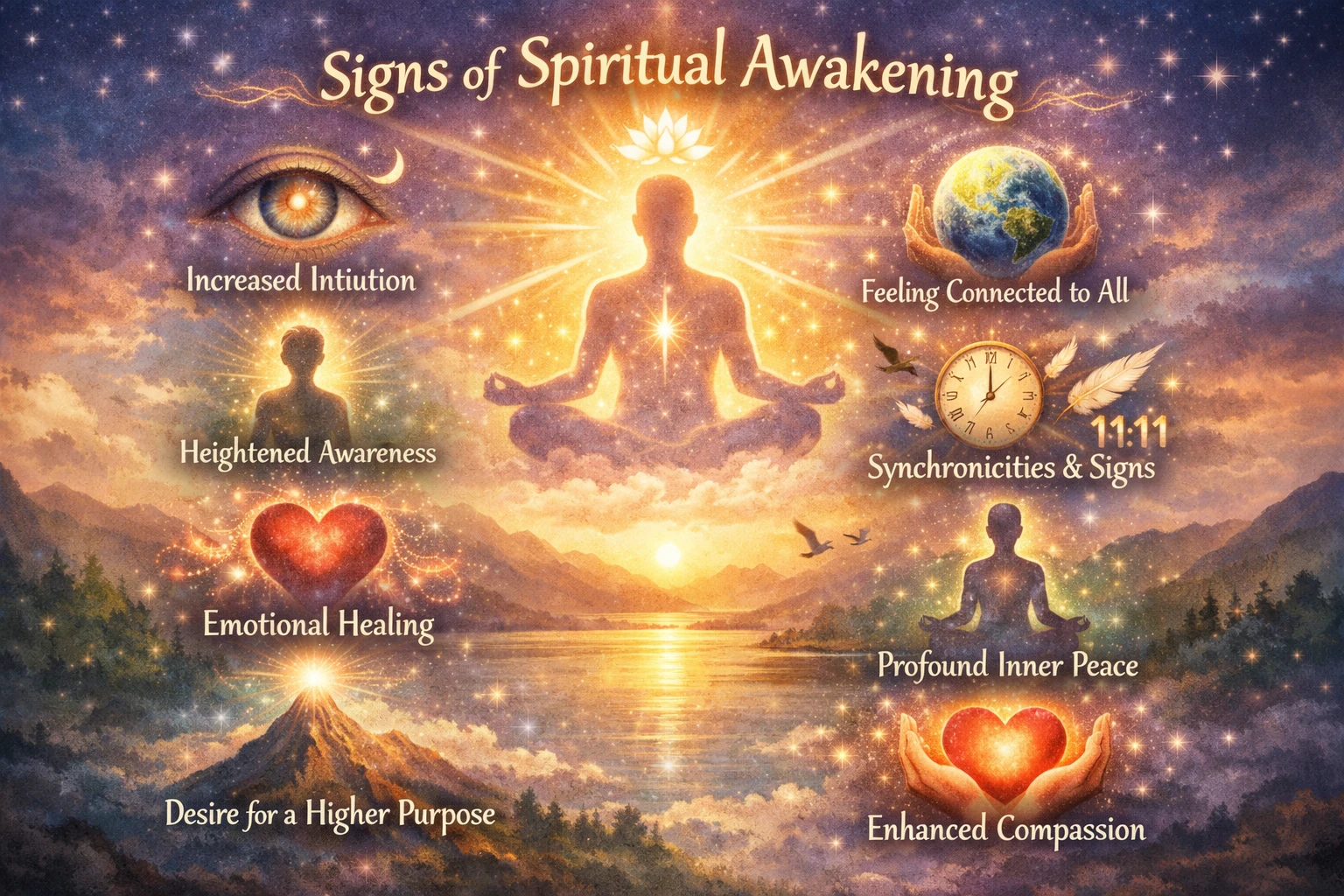
People who have undergone spiritual awakening often report changes in mindset and behaviour. Key indicators (with representative sources) include:
- Values Shift: A clearer sense of meaning and purpose emerges. Often material concerns diminish, while altruism and ecological consciousness increase. For instance, altruistic concern for others consistently rises in meditation practitioners. Awakening is frequently followed by “re-evaluation” of goals and a desire to contribute (Monteiro et al., 2025).
- Enhanced Compassion and Connection: A hallmark is deeper empathy and love for others. Brain imaging links this with activity in social cognition networks. Clinically, awakenings often lead to greater altruism; studies of meditation practitioners show increased prosocial behaviour (Condon et al., 2013). People describe a felt unity with humanity and nature.
- Altered Sense of Self: A weakened ego or self-centered identity. Individuals might report feeling like a “drop in the ocean” of consciousness. This aligns with neurological findings of reduced DMN activity. Philosophers refer to non-dual awareness – the subjective experience of not feeling separate from experience. Increased present-moment awareness and less ruminative self-talk are common.
- Heightened Sensitivity: Both sensory and emotional sensitivity often rise. Colors, sounds, and tastes may seem more vivid; emotions may be more intense but also more fluid. This sensory openness can be disorienting at first. It may relate to increased interoceptive awareness (body-awareness) noted in advanced meditators. Monteiro et al. identify a “sensory–perceptual domain” as central to awakening.
- Spiritual Experiences: Many notice synchronicities or receive intuitive insights (e.g. sudden clarity or dreams with symbolic meaning). For example, Greyson (2004) found that many spiritual awakenings involve altered states (visions, lights) similar to near-death or mystical experiences. However, since such phenomena also occur in various contexts, discernment is key.
- Emotional Well-being and Peace: Typically, a lasting sense of inner peace or equanimity develops. Even when anxiety remains, a baseline calmness often emerges. This is supported by studies of meditation showing increased gamma synchrony correlating with blissful states (Lutz et al., 2004). Many describe ongoing gratitude or awe as everyday experience.
Timelines and Trajectories: Awakening can be gradual or sudden. Some practitioners report a sudden, unbidden event (kūndalinī awakening, enlightenment satori), often triggered by intense practice or crisis. Others slowly accumulate insights over years. Integration often involves cycles: after an initial “peak” experience, individuals may face a period of disorientation (often called a dark night or purification phase) followed by settling in. Grofs’ model of the four stages (liberation, insight, ego death, return) is one framework, but personal variability is high.
Comparing Signs: Mechanisms and Reliability
| Sign/Indicator | Likely Mechanism | Reliability |
|---|---|---|
| Increased compassion and empathy | Neuroplastic changes in social circuits; somatic markers of others’ distress | High (common in awakenings) |
| Altered sense of self (ego loss) | Deactivation of DMN; implicit cognition shifts | Medium–High (key sign but sometimes transient) |
| Values reorientation (less materialism) | Cognitive reframing through insight; affective tagging in new beliefs | Medium (often reported but subjective) |
| Heightened sensory/emotional sensitivity | Increased interoception; reduction of psychological filters | Medium (common, but also could be stress response) |
| Synchronicities and intuition | Pattern detection (apophenia), altered attention | Low (very common cognitive bias) |
| Persistent sense of peace or joy | Sustained neurochemical balance, strong positive affect | Medium (frequently reported, but study-dependent) |
(Table: Common observable changes in spiritual awakening, their cognitive/neural mechanisms, and how reliably they indicate authentic transformation. “Reliability” is a heuristic indication of how strongly the sign correlates with bona fide awakening, based on survey and clinical data.)
Distinguishing Awakening from Pathology
It is critical to differentiate spiritual emergence from mental illness. Key distinctions (paraphrased from Crowley 2006) are:
- Insight vs confusion: Awakening usually includes insight and recognition that one’s perceptions are altered; psychosis often includes delusional conviction and confusion.
- Adaptive vs maladaptive: Awakening tends to eventually enhance life meaning; psychosis typically impairs function. If symptoms cause significant distress, confusion, or risk, professional help should be sought.
- Volition: Emerging states, even if intense, often feel self-transcendence is voluntary or enlightening; in clinical break, experiences feel imposed and frightening.
Red flags that warrant evaluation include extreme paranoia, suicidal urges, or sustained inability to distinguish reality. However, many therapists now suggest a sympathetic approach: for example, not immediately medicating an “awakening crisis” if possible, but offering psychological support (adapted from Grofs’ model).
Measurement and Research Challenges
Assessing awakening scientifically is difficult. Experiences are subjective and culturally laden. Some psychometric tools exist:
- Hood Mysticism Scale (1975): measures traits like unity and ineffability (based on Stace’s framework).
- Daily Spiritual Experience Scale (DSES): measures frequency of felt closeness to the divine in daily life.
- Mystical Experience Questionnaire (MEQ) (Griffiths et al., 2006): used in psychedelic studies to quantify peak experiences.
- Spiritual Transcendence Scale (Piedmont, 1999): measures connectedness and reverence.
- Spiritual Emergence/Spiritual Crisis (SES, SCCS) scales: developed to identify positive and negative aspects of emergence.
All these have limitations: they rely on self-report and may not capture the depth of change over time. There is also risk of spiritual bypassing (going through the motions of awakening without true integration) which is hard to detect with scales alone.
Empirical research on awakening is sparse compared to studies on mystical states (e.g. psychedelics) and meditation. Much of the literature comes from qualitative reports or small cohorts. Therefore, findings are provisional and often culture-specific. For example, Western college students scoring high on the Mysticism Scale may not represent traditional spiritual adepts.
Controversies and Open Questions
- Spiritual Bypassing: Coined by Welwood (1984), bypassing is using spiritual concepts to avoid unresolved issues. Critics warn that glorifying awakening can lead people to overlook mental health needs. There is ongoing debate whether intense experiences are inherently beneficial or can be narcissistic.
- Cultural Appropriation: Many modern “awakening” frameworks borrow from Eastern or indigenous traditions. Scholars caution that without contextual understanding, such appropriation can distort practices. Authenticity vs syncretism is contested.
- Pseudoscience: The field attracts pseudoscientific claims (e.g. marketing dubious “awakening” courses, misusing neuroscience buzzwords). Rigour demands distinguishing tested techniques (e.g. mindfulness) from fad therapies.
- Open Questions: Neurobiologically, what differentiates a temporary mystical state from a durable transformation? How do personality and genetics influence susceptibility to awakening? What is the role of crisis (illness, trauma) in catalysing genuine awakening vs just breakdown? More longitudinal and cross-cultural research is needed to clarify these.
In conclusion, spiritual awakening is a multifaceted phenomenon with cognitive, emotional, and transcendent dimensions. While many subjective signs are documented (compassion, unity, peace, etc.), rigorously assessing them remains a challenge. Evidence-based guidance emphasizes grounded practices, community support, and balancing openness with critical thinking to navigate the path safely.
As you navigate this profound shift in consciousness, remember that a spiritual awakening is rarely a linear path—it is a continuous unfolding. To deepen your understanding of the subtle ways the universe communicates with you, explore our guide on the Spiritual Meaning of Dreams, where your subconscious speaks in the language of symbols. If you’ve been noticing strange coincidences in your daily life, our deep dive into Recognizing Signs and Synchronicity will help you decode those meaningful patterns. Finally, as your inner compass grows stronger, learn to distinguish your soul’s voice from your mind’s noise by visiting our article on the Signs your intuition is guiding you. Embrace the journey; you are exactly where you need to be.
To ensure you never miss a cosmic nudge, subscribe to our push notifications—we’ll send a little spark of wisdom directly to you whenever a new guide drops!
References
Crowley, N. (2006). Psychosis or Spiritual Emergence? Royal College of Psychiatrists (PDF). (On distinguishing spiritual emergency vs pathology). Link PDF
Brewer, J. A., Worhunsky, P. D., Gray, J. R., Tang, Y.-Y., Weber, J., & Kober, H. (2011). Meditation experience is associated with differences in default mode network activity and connectivity. Proceedings of the National Academy of Sciences, 108(50), 20254–20259. DOI: 10.1073/pnas.1112029108 . (Demonstrates reduced DMN activity in meditators).
Grof, S., & Grof, C. (1989). Spiritual emergency : when personal transformation becomes a crisis (1st ed.). Tarcher. http://catdir.loc.gov/catdir/enhancements/fy1206/89034831-b.html (Coined “spiritual emergency” vs pathologizing).
Hood, R. W. (1975). The Construction and Preliminary Validation of a Measure of Reported Mystical Experience. Journal for the Scientific Study of Religion, 14(1), 29–41. https://www.jstor.org/stable/1384454 . (Mysticism scale).
Lutz, A., Greischar, L. L., Rawlings, N. B., Ricard, M., Davidson, R. J. (2004). Long-term meditators self-induce high-amplitude gamma synchrony during mental practice. PNAS, 101(46), 16369–16373. https://doi.org/10.1073/pnas.0407401101 . (Neural correlates of experienced meditators).
Monteiro, M., Vitorino, J., Salvetti, M. G., & Laranjeira, C. (2025). Seeking Something Beyond Themselves: A Concept Analysis of Spiritual Awakening Experiences at the End of Life. Nursing Reports, 15(10), 358. https://doi.org/10.3390/nursrep15100358 (Identifies sensory, affective, relational, transcendental domains of awakening).
Fenwick, P.B. (2005). Science and Spirituality: A Challenge for the 21st Century [The Bruce Greyson Lecture from the International Association for Near-Death Studies 2004 Annual Conference]. Journal of Near-Death Studies, 23, 131-157. DOI:10.17514/jnds-2005-23-3-p131-157
Welwood, J. (1984). Principles of inner work: Psychological and spiritual. Journal of Transpersonal Psychology, 16(1), 63–73. https://psycnet.apa.org/record/1985-15194-001
Piedmont, Ralph. (1999). Does Spirituality Represent the Sixth Factor of Personality? Spiritual Transcendence and the Five‐Factor Model. Journal of personality. 67. 10.1111/1467-6494.00080. DOI:10.1111/1467-6494.00080
Griffiths, R. R., Richards, W. A., McCann, U., & Jesse, R. (2006). Psilocybin can occasion mystical-type experiences having substantial and sustained personal meaning and spiritual significance. Psychopharmacology, 187(3), 268–292. https://doi.org/10.1007/s00213-006-0457-5
Condon, P., Desbordes, G., Miller, W. B., & DeSteno, D. (2013). Meditation increases compassionate responses to suffering. Psychological science, 24(10), 2125–2127. https://doi.org/10.1177/0956797613485603
Carhart-Harris, R. L., Leech, R., Hellyer, P. J., Shanahan, M., Feilding, A., Tagliazucchi, E., Chialvo, D. R., & Nutt, D. (2014). The entropic brain: a theory of conscious states informed by neuroimaging research with psychedelic drugs. Frontiers in human neuroscience, 8, 20. https://doi.org/10.3389/fnhum.2014.00020
Hölzel, B. K., Carmody, J., Vangel, M., Congleton, C., Yerramsetti, S. M., Gard, T., & Lazar, S. W. (2011). Mindfulness practice leads to increases in regional brain gray matter density. Psychiatry research, 191(1), 36–43. https://doi.org/10.1016/j.pscychresns.2010.08.006
Varela, F. J. (1996). Neurophenomenology: A methodological remedy for the hard problem. Journal of Consciousness Studies 3 (4):330-49. Link PDF
