

INTRODUCTION
Intuition can be defined as a rapid, non-analytical way of knowing or deciding – often experienced as a “gut feeling” or hunch. Unlike deliberate reasoning, intuition often emerges gradually from experience (e.g. experts recognise patterns). In contrast, insight is typically sudden and discontinuous, whereas spiritual intuition (mystical knowing) carries an additional sense of noetic quality – a feeling of profound insight. Observable signs of intuitive guidance include bodily sensations (butterflies, heart racing), a strong feeling of certainty or “rightness,” positive affective tagging, and a sense of pattern- or familiarity-based knowing. Coincidences or “synchronicities” are often seen as meaningful by intuitive persons, though they remain controversial as evidence. The reliability of these indicators varies: pattern-recognition in experts is generally more dependable than vague “feelings.” Context matters: intuition works best in predictable environments with ample feedback. Stress, anxiety or lack of experience can distort gut feelings. To test or validate a hunch, one can use techniques like premortems (imagine failure scenarios), small-scale experiments, keeping a decision journal, and using objective rules (statistics or second opinions) to cross-check. Throughout, beware cognitive biases – such as confirmation and hindsight bias – which can make us overconfident in retrospective intuition. In sum, intuition is a complex mix of learned pattern matching, emotional tagging, and bodily feedback. We review its definitions, signs, moderators and practical testing protocols below, drawing on psychological and neuroscientific evidence.
Defining Intuition (vs Insight and Spiritual Intuition)
In cognitive science, intuition is often described as arriving at a judgment or solution without conscious, step-by-step reasoning. Zander et al. note that intuition yields ideas “by sensing the solution without any explicit representation”. It is typically gradual and experience-based: as a person gains expertise, knowledge becomes tacit and can produce fast judgments (e.g. an experienced firefighter “knowing” a building will collapse). By contrast, insight involves a sudden reorganization of information (the classic “aha!” moment) and is usually discontinuous.
“Spiritual intuition” or mystical knowing carries the same phenomenology (sudden clarity, strong conviction) but is interpreted in a spiritual framework. William James famously described mystical experiences as having a noetic quality – they feel deeply true and enlightening – as well as being ineffable and passive (happening to the person). Thus, while secular intuition might guide a business decision, spiritual intuition might feel like divine guidance. In practice, the subjective markers overlap: both feel convincing and beyond ordinary analysis.
Observable Signs of Intuition
People report a variety of clues when intuition strikes. Empirical research and theory highlight several signs that often accompany intuitive insight:
- Somatic Signals: Physical sensations – butterflies in the stomach, a knot in the gut, racing heart, sweating palms – can signal that a choice is risky or important. This reflects the somatic marker process (Damasio, 1996): unconscious bodily feedback (heart rate, gut tension) that flags emotionally significant options. Studies show that individuals with good interoceptive awareness (e.g. accurately sensing heartbeats) tend to use these bodily cues effectively in decision tasks. For example, Dunn et al. (2010) found that people better at tracking their heartbeat learned to avoid bad choices faster in a card game – their bodies “warned” them before they consciously knew why. (However, bodily signals can mislead if misinterpreted: some participants’ heartbeats actually inverted and led them astray.) In practice, noticing a strong bodily reaction when considering options can be a sign of an intuitive warning or endorsement.
- Sudden Clarity or Noetic Feeling: A hallmark of intuition is the experience of knowing without knowing how. People often say “I just know this is right,” or have a flash of understanding (“it all clicks”) that is hard to articulate. This noetic sensation – feeling that the answer is true – is noted in both intuition and spiritual contexts. Psychologist Carina Remmers observes that intuitive outcomes come with a metacognitive feeling of rightness or confidence, distinct from reasoning. In other words, a hunch often carries a subjective conviction.
- Affective Tagging: Intuitive ideas often trigger positive or negative affect. A thought that “feels good” or “relieves stress” may coincide with accessing a stored solution (for instance, choosing a design option might suddenly excite an “aha” feeling). Conversely, a growing sense of unease or tension can indicate an unconscious alert. This is linked to the somatic markers as well – the body’s emotional tagging of different options. Remmers (2022) notes that gut decisions are strongly connected to emotional and bodily cues, which may indicate alignment with personal needs. Thus, an easy, pleasant feeling may suggest a coherent intuitive hit, whereas a sinking feeling may caution against it.
- Pattern Recognition / Familiarity: Experts often experience intuition as seeing a pattern instantly. A doctor might immediately sense a diagnosis from subtle cues, or a chess player intuitively choose a move because the position “looks familiar” from past games. This sign is arguably the most reliable: it’s rooted in extensive practice. Kahneman and Klein (2009) emphasise that true intuitive expertise requires a predictable environment and many learning opportunities. When these are present, pattern-based intuitions are often accurate (e.g. recognizing a word as authentic vs. a forgery). In contrast, novice “pattern matches” are more likely to be wrong. In summary, a sense of familiarity or instant pattern match is a strong intuitive indicator if you are in a domain of expertise.
- Synchronicities or Coincidences: Some people interpret unusual coincidences as intuitive signs (e.g. thinking of a friend who then calls). Carl Jung coined this synchronicity, an “acausal connecting principle” where meaning is ascribed to coincidental events. While no scientific consensus exists that coincidences carry predictive power, noticing synchronicities can be subjectively meaningful. Researchers caution that coincidence can be compelling, but it often reflects our pattern-seeking bias (we notice the hits and forget the misses). As a “sign,” synchronicities are controversial and should be treated with scepticism.
These signs vary in reliability and origin. The table below summarises them, with rough assessments of how consistently they predict good outcomes in ideal conditions. (These ratings are illustrative; reliability depends on context and individual differences.)
| Sign / Indicator | Likely Mechanism | Indicative Reliability |
|---|---|---|
| Physical sensations (gut, heart, “butterflies”) | Somatic markers from emotional arousal (Damasio 1996) | Medium (helpful if interpreted correctly) |
| Sudden clarity / knowing (“noetic” feeling) | Fast unconscious pattern matching | Low–Medium (subjective conviction but can be illusory) |
| Positive affect or relief | Emotion/integrative processing (Remmers 2022) | Medium (pleasant feelings often follow right decisions) |
| Instant pattern recognition | Expert’s tacit knowledge / heuristics | High (for true experts in stable domains) |
| Meaningful coincidences | Cognitive confirmation (pattern-seeking bias, Jung) | Low (often coincidence, prone to bias) |
Situational Moderators of Intuition
Intuition does not operate in a vacuum. Several factors strongly influence when a “gut feeling” is likely to be valid:
- Expertise and Feedback: A long track record in a field is the single most important moderator of intuition quality. Professionals (firefighters, athletes, doctors) with years of practice can often rely on intuition within the narrow domain they know well. Kahneman and Klein (2009) emphasize that intuition flourishes in environments that are stable and provide immediate feedback. If a soldier repeatedly faces similar tactical situations and quickly learns from outcomes, his gut decisions improve. By contrast, in unpredictable or new situations, even an expert’s gut is unreliable. Thus, when judging a hunch’s strength, consider whether you have deep experience and a history of feedback in that area.
- Mood and Emotion: Your current emotional state can color intuition. Positive mood tends to broaden thinking and can make intuitive leaps feel more fluent (though sometimes at the cost of detail). Remmers (2022) found intuitive decisions often improve mood – but depressed or anxious people commonly report losing trust in intuition. Indeed, anxiety or stress may produce distracting bodily arousal (racing heart) that doesn’t clearly map to the decision itself, making the “signal” noisy. Empirical work suggests that when people are very anxious or depressed, their gut responses weaken or reverse, so extreme states are poor conditions for trusting a hunch. In practice, a calm, neutral frame of mind usually allows clearer insight.
- Stress and Fatigue: Moderate stress can heighten alertness (potentially amplifying somatic signals), but high stress and fatigue often impair judgment. When overloaded, the brain defaults to well-worn habits – which can help if those habits are good, but lead to errors if not. An intuitive alert may either be attenuated or oversimplified under stress. Mindfulness and brief pauses can help filter out generic stress signals and refocus on relevant cues.
- Feedback and Calibration: The better a person has calibrated their intuition by keeping track of outcomes, the more reliable their instincts. For example, people who engage in decision journaling or reflection learn to distinguish true “hits” from lucky guesses. Without such calibration, individuals often fall prey to confirmation bias – remembering only the times intuition was “right.” Over time, untested intuition can seem infallible (hindsight bias) unless actively checked. Periodic feedback (e.g. comparing predictions to reality) helps maintain honest judgment.
Testing and Validating a Hunch
Given intuition’s fallibility, it is wise to subject major hunches to scrutiny. Here are evidence-based strategies to evaluate your intuitive insights:
- Premortem Analysis: Instead of only asking “What could go right?”, imagine the decision has failed and work backward. This process (promoted by psychologists and strategists) surfaces hidden assumptions and risks. By explicitly listing reasons the hunch might fail, you counteract overconfidence and confirmation bias.
- Hypothesis Testing (Small Experiments): Treat your intuition as a hypothesis. Where possible, run a low-stakes test before fully committing. For example, if your gut says a business idea will work, conduct a mini survey or pilot. If it’s a personal decision, try a “test run” of behavior. Look for consistency: does the test outcome align with your feeling? Dunn et al. showed that unconscious signals predicted success only when aligned with conscious action. A quick experiment can reveal whether your intuition was a true pattern hit or merely wishful thinking.
- Record-Keeping: Keep a decision journal. Write down intuitions and the reasons for following or dismissing them, and later note outcomes. Over time, such records improve metacognitive awareness. They help counter hindsight bias by providing a factual check on how accurate your hunches were. Writers like Klein and behavioral economists recommend journaling to identify which kinds of hunches pay off.
- Second Opinions and Rules: Use decision rules and peer input to challenge your intuition. For example, quantify base rates (“What do most people do?”) or list objective pros and cons. Psychologists suggest combining intuition with analysis: if a hunch conflicts with data or general trends, proceed with caution. Getting a trusted colleague’s perspective can uncover blind spots. Essentially, cross-check your gut with external signals.
These steps are not foolproof, but they mitigate biases. Remmers warns that subjective feelings alone are not reliable indicators, so supplement gut instincts with hard evidence whenever possible.
Measurement Challenges and Common Biases
Studying intuition scientifically is hard: it’s intangible, varies by person and situation, and resists direct measurement. Self-report scales exist (e.g. Myers-Briggs Intuition/Sensing, Epstein’s Rational-Experiential Inventory) but capture general preferences more than moment-to-moment intuition. Research suggests people overestimate the accuracy of their instincts (often called overconfidence). Common pitfalls include:
- Confirmation Bias: We tend to notice and remember instances when our hunch was right, ignoring times it was wrong. This inflates our confidence in intuition. Always ask: “What about the times I was wrong?”
- Hindsight Bias: After an outcome is known, people often feel they “knew it all along,” reinforcing belief in intuition. Journaling (above) helps prevent rewriting history.
- Motivated Reasoning: Our desires influence which intuitive inklings we trust. We might “hear” a hunch we want. Checking motives (e.g. personal gain) is crucial.
Given these issues, experts advise viewing intuition as useful data, not divine revelation. As Kahneman & Klein concluded, intuition can be exceptional only under the right conditions. Otherwise, a structured approach is safer.
Table: Signs of Intuition, Mechanisms, and Reliability
| Observable Sign | Mechanism | Typical Reliability |
|---|---|---|
| Gut/physical feeling | Bodily arousal/somatic marker signaling (Damasio 1996) | Medium (good if accurately perceived; can mislead if misinterpreted) |
| *Sudden certainty (“just know”) ** | Rapid unconscious pattern match (Zander et al., 2016) | Low–Medium (compelling but subjective) |
| Positive feeling (relief/joy) | Integrated affective cue (feeling-of-rightness) | Medium (often follows correct choice) |
| Instant pattern recognition | Learned heuristics/expertise | High (for true experts in familiar domains) |
| Synchronicities (coincidence) | Perceived meaning; confirmation bias (Jung 1952) | Very Low (mostly chance) |
(Figure: Relative reliability of common intuitive indicators. Pattern recognition by experts is most dependable; coincidences are least so.)
Flowchart: Evaluating an Intuitive Hunch
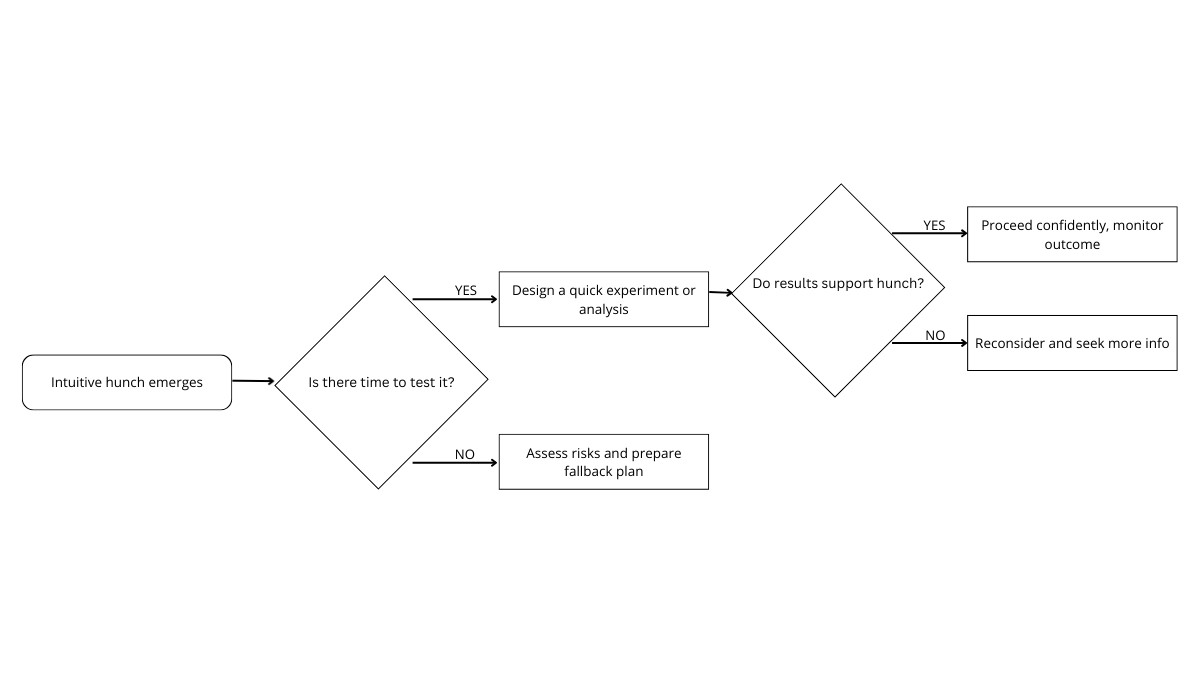
Figure: A decision-testing protocol. If time permits, subject the hunch to a small test; if results align, you may proceed, otherwise re-evaluate. If under time pressure, limit downside with contingency plans.
In my next post, I will talk about the spiritual meaning of dreams. You don’t want to miss it, so stay tuned! Whenever you need a bit of clarity or intuitive guidance, feel free to reach out to me here.
References
Dunn, B. D., Galton, H. C., Morgan, R., Evans, D., Oliver, C., Meyer, M., Cusack, R., Lawrence, A. D., & Dalgleish, T. (2010). Listening to your heart: How interoception shapes emotion experience and intuitive decision making. Psychological Science, 21(12), 1835–1844. DOI: 10.1177/0956797610389191.
Kahneman, D., & Klein, G. (2009). Conditions for intuitive expertise: a failure to disagree. American Psychologist, 64(6), 515–526. PMID: 19739881 DOI: 10.1037/a0016755
Remmers C, Topolinski S, Knaevelsrud C, Zander-Schellenberg T, Unger S, Anoschin A, Zimmermann J. Go with your gut! The beneficial mood effects of intuitive decisions. Emotion. 2024 Oct;24(7):1652-1662. doi: 10.1037/emo0001385. Epub 2024 Jun 13. PMID: 38869852.
Zander, T., Öllinger, M., & Volz, K. (2016). Intuition and insight: Two processes that build on each other or fundamentally differ? Frontiers in Psychology, 7, 1395. https://www.frontiersin.org/journals/psychology/articles/10.3389/fpsyg.2016.01395.
Damasio, A. R. (1996). The somatic marker hypothesis and the possible functions of the prefrontal cortex. Philosophical Transactions of the Royal Society B, 351(1346), 1413–1420. https://doi.org/10.1098/rstb.1996.0125.
Nickerson, R. S. (1998). Confirmation bias: A ubiquitous phenomenon in many guises. Review of General Psychology, 2(2), 175–220. https://doi.org/10.1037/1089-2680.2.2.175.
Jung, C. G. (1952). Synchronicity: An Acausal Connecting Principle. Bollingen Series XVI. Princeton University Press.

One thought on “Signs your intuition is guiding you”